



Unlearn & Understand: 10 Books To Help Heal Latinx Generational Trauma
There’s nothing like getting lost in a book, especially when you’re healing a broken heart… or a few generational wounds. While no book will ever have all the answers to the bumps in your life story, there’s something magical about connecting with characters you come across. It’s healing to see your struggle and your growth in their character arcs.
Reading is also a special form of self-care because it cues your nervous system to relax. It can help ease your anxiety or distract your mind from spiraling thoughts. It can offer stories to get lost in or tools to use as you explore your generational trauma.
These eight books aren’t the end-all, be-all, but serve as an entry point to discovering stories that connect with where you are in your journey today.
“Of Women and Salt” by Gabriela García
Gabriel García’s debut novel, “Of Women and Salt,” explores generational trauma through the lens of five generations of Cuban women. You meet different women’s perspectives throughout, from the 19th century through modern-day interactions with ICE, and more importantly, you peek into how these women grapple with their personal histories.
“Break the Cycle: A Guide To Healing Intergenerational Trauma” by Dr. Mariel Buqué
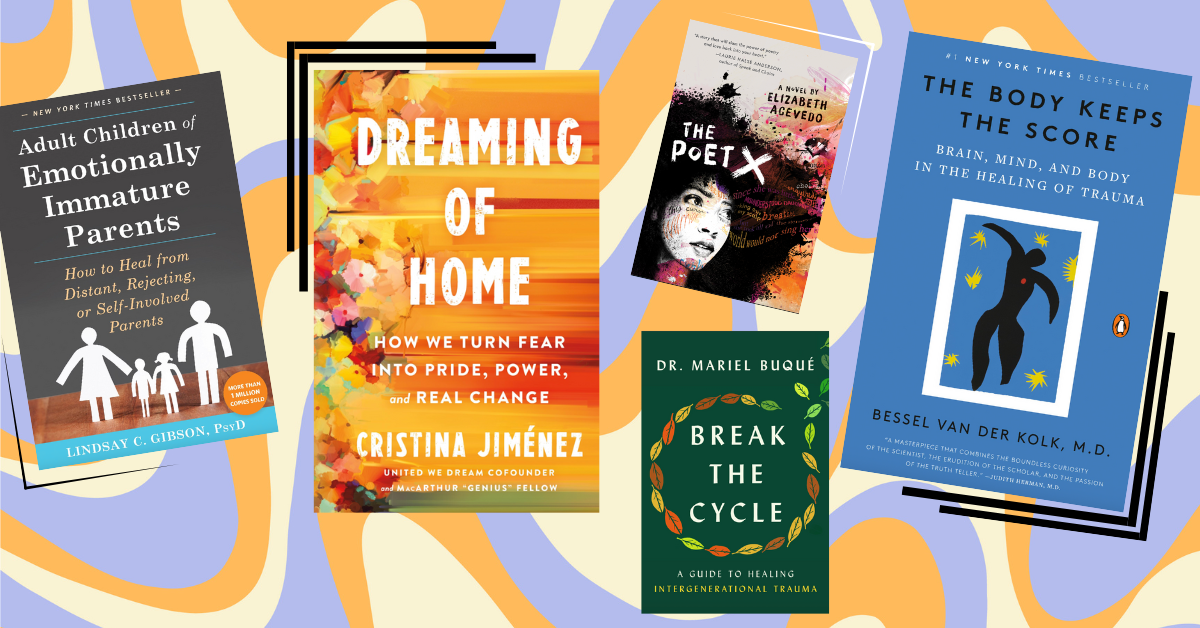
Dr. Mariel Buqué’s “Break the Cycle: A Guide To Healing Intergenerational Trauma” is exactly that — a soft hand to hold. At the same time, you unpack how Latinx families impact how you move through the world today. The guide provides actionable tools and a range of healing modalities to support you as you move forward.
“The Poet X” by Elizabeth Acevedo
Another work of fiction, “The Poet X” by Elizabeth Acevedo, puts you in the mind of the main character, Xiomara Martínez. Throughout the young adult novel, readers meet a character who manages to push beyond the constraints of her family and neighborhood to reimagine what freedom and expression mean to her.
“Self-Care for Latinas” by Raquel Reichard
While not specifically addressing generational trauma, Reichard’s book encourages Latinx individuals to embrace self-care in a way that may be entirely new for them. Throughout the book, you’ll find tangible ways to care for yourself, whether you’re a self-care beginner or expert.
“Dreaming of Home: How We Turn Fear into Pride, Power, and Real Change” by Cristina Jiménez
In her debut memoir, Cristina Jiménez unpacks her own American story. She details her and her family’s journey immigrating to the United States from Ecuador, and in doing so, lets others into the many layers that come with living as an immigrant in America, especially today.
“It Didn’t Start With You” by Mark Wolynn
“It Didn’t Start With You” is a nonfiction book written by Mark Wolynn, a leading expert in family trauma. Throughout the book, he delves into research, interviews, and analysis on how intergenerational trauma is passed down from one generation to the next. He provides practical advice and strategies to help you trace your family’s trauma through generations and discover lasting methods for healing.
“The Body Keeps the Score” by Bessel van der Kolk
The mind-body connection is undeniable. It’s why anxiety can often present for some as spiraling thoughts, while for others as a physical tightening of the chest. In his bestselling book, Dr. Bessel van der Kolk unpacks exactly what it means for the body to keep score, how it stores those old memories and triggers, and what to do to heal those connections.
“Adult Children of Emotionally Immature Parents: How to Heal from Distant, Rejecting, or Self-Involved Parents” by Lindsay C Gibson
You may be the first person in your family to challenge your generational trauma or to try to find paths towards healing or moving forward. While this is commendable and amazing, it can also be a lonely experience. It may also spotlight how your parents did little emotional work on themselves as they grew up, whether because they didn’t want to or they simply didn’t know it was an option. Lindsay C. Gibson’s “Adult Children of Emotionally Immature Parents” is a TikTok favorite recommendation for anyone trying to heal old family wounds.
“The Let Them Theory” by Mel Robbins
This 2025 has been a ‘let them’ year ever since Mel Robbins’ “The Let Them Theory” hit bookshelves. While Robbins doesn’t speak specifically about generational trauma, her book is rooted in the premise that you should shift your focus to what you can control and release all you can’t. As you process family trauma or navigate personal healing, you may find Robbins’s take helpful.
“What Happened To You?: Conversations on Trauma, Resilience, and Healing” by Bruce D. Perry, Oprah Winfrey
Oprah Winfrey partners with trauma expert Bruce D. Perry to shift the conversation around trauma to one of healing. “What Happened To You?” attempts to replace the question “what’s wrong with me?” so that there’s more of an opportunity to find a path forward from childhood traumas and experiences.
Your journey to healing generational trauma is probably not linear or ever fully finished. Instead, it’s a journey you piece together day by day. You try to find the best resources along the way to help, books included!